
By Eric Weller, President, Newport Tool & Machine, Inc.
Manufacturing output fell 0.3 percent in August after rising for seven straight months. Capacity utilization for manufacturing slipped to 75.7 percent, a rate the Federal Reserve puts 2.5 percentage points below its 1972-to-2025 average.
Read that as a buyer rather than as an economist. American factories are running with room to spare.
That matters to anyone sourcing precision CNC machining right now. Slack capacity is when quoting gets competitive, and it is also when the real differences between shops stop hiding behind backlog.
Capacity is available. Capability is the question.
A shop with open spindles is not the same as a shop that can hold your part.
The durable-goods picture underneath the headline number was soft in August. Business equipment output slipped 0.5 percent and defense and space equipment fell 1.2 percent. Durable manufacturing as a whole declined 0.5 percent, with declines spread broadly across categories.
Broad softness tends to make buyers price-shop. My own view, after five decades in this trade, is that a soft quarter is the wrong moment to trade a supplier who can hold a hard part for one who cannot. Capacity comes back. Capability takes decades.
Washington is betting on smaller shops
On September 15, 2026, NIST awarded more than $30 million to 12 Manufacturing Extension Partnership centers to help small and medium-sized manufacturers adopt advanced manufacturing technology, including AI, robotics, automation, and additive manufacturing.
Pennsylvania IRC Network received $6,110,684, the second-largest award in the group.
For a buyer, that is a signal about where technical depth is being built. The money is going toward the tier of shop that machines components rather than assembles finished goods.
Most parts start with milling or turning
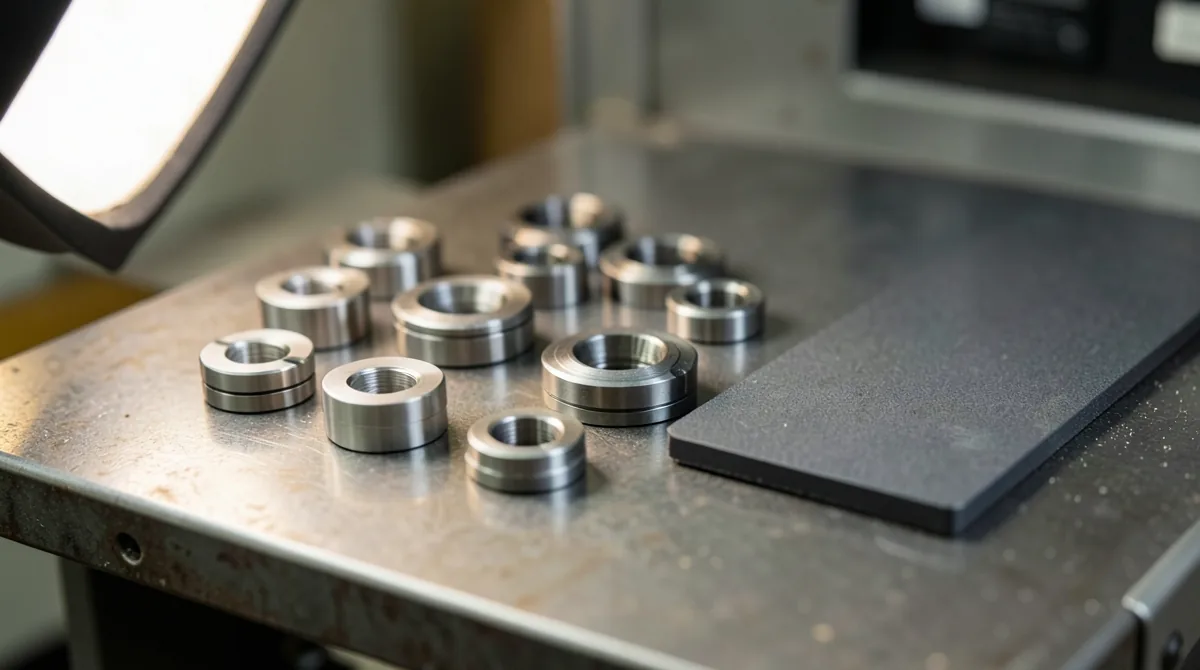
Nearly every precision component a buyer sources begins on a mill or a lathe, and plenty need both.
The question is not which process is better. The question is which one owns your part, how many setups it takes, and whether one shop can carry it from first operation to last.
Two pieces go deeper. One covers what each axis on a mill actually buys you, in cost and in setups. The other covers the documentation behind a turned part, and why the standard governing it changed this month.
Industries do not ask the same questions
Aerospace asks about documentation and repeatability across decades. Medical asks about inspection records and traceability. Marine asks about material behavior in salt water. Electronics and fiber optics ask about tight tolerances on small features. Entertainment asks whether stage hardware survives a touring season.
A shop serving one of those has learned one set of habits. A shop serving several has had to learn all of them, and the habits transfer. The inspection discipline an aerospace program demands is what makes a medical component repeatable.
What to ask a machine shop in a soft market
Ask what runs in-house and what gets subcontracted, because every handoff between buildings adds a shipping leg and a queue. Ask who programs the job and whether you can talk to them. Ask how long the people on the floor have been doing this work.
Price is easy to compare across four quotes. Those answers are harder to get and tell you more.
Frequently Asked Questions
01What does capacity utilization tell a machining buyer?
It measures how much of the nation’s manufacturing capacity is in use. The Federal Reserve put manufacturing at 75.7 percent in August, 2.5 percentage points below its long-run average. Lower utilization generally means shops have open capacity, which tends to make quoting more competitive.
02Should I consolidate machining vendors or spread the work?
Consolidating works when one shop genuinely runs the processes your part needs in the same building. Each transfer between suppliers adds transit, queue time, and another party to the quality record. Spreading work makes sense when no single shop covers the full process chain your drawing requires.
03What is a Manufacturing Extension Partnership center?
MEP centers are NIST-supported organizations that help small and medium-sized manufacturers adopt advanced technology and improve operations. NIST awarded more than $30 million across 12 centers in September 2026, with Pennsylvania IRC Network receiving the second-largest share at just over $6.1 million.
04Does one machine shop handle aerospace and medical work?
Many do. The disciplines overlap, since both markets run on documented inspection, traceability, and repeatability. Certification requirements differ by industry, so confirm which certifications a shop actually holds rather than assuming industry experience implies a credential.
05How do I compare machining quotes fairly?
Compare what is included, not just the number. Ask which operations run in-house, how many setups the shop plans, what inspection documentation ships with the parts, and who programs the job. Quotes that differ on price often differ on scope.
NTM: Seven Processes, One Floor, Since 1972
Newport Tool & Machine is a family-owned CNC machine shop in Newport, Pennsylvania, run by three generations of the same family since 1972. Milling, turning, Swiss, EDM, grinding, heat treat, and inspection all happen in one 50,000 square foot building. ISO 9001:2015 certified through 2029.
Our Processes Include:
- CNC Milling — 25 mills with 3, 4, and 5-axis capability on Brother, Mori Seiki, Fanuc, and Feeler equipment
- CNC Turning — 10 lathes with twin spindle, Y-axis, and live tooling on Mori Seiki, Nakamura, Hardinge, Doosan, and Okuma equipment
NTM machines components for aerospace, medical, military, firearm, electronics, fiber optics, aviation, mass transit, advanced marine, and entertainment. More on each is on the Industries page.
Have a part that is hard to quote?
Send NTM the print and talk it through with the people who will machine it.
About the Author
Eric Weller is president of Newport Tool & Machine, the family-owned CNC machine shop his father Ron founded in Newport, Pennsylvania in 1972. He has been around the shop since he was four years old, back when the company ran out of the family basement on three manual machines. He joined full-time out of high school in 1989 and worked through the floor, estimating, and production planning before taking over. He is the second of three generations at NTM, and he still reviews quotes and answers customer process questions himself.
Works Cited
- Board of Governors of the Federal Reserve System. “Industrial Production and Capacity Utilization — G.17.” 18 Sept. 2026, www.federalreserve.gov/releases/g17/current/default.htm.
- United States, National Institute of Standards and Technology. “NIST Awards More Than $30 Million for MEP Centers in 11 States and Puerto Rico.” U.S. Department of Commerce, 15 Sept. 2026, www.nist.gov/news-events/news/2026/09/nist-awards-more-30-million-mep-centers-11-states-and-puerto-rico.