
By Eric Weller, President, Newport Tool & Machine, Inc.
Manufacturers are sitting on a backlog. The Census Bureau reported unfilled orders of $1,600.3 billion in July, up in twenty-four of the last twenty-five months, against shipments of $658.8 billion. The unfilled-orders-to-shipments ratio stood at 6.81.
Backlog is the context every quoting decision sits inside. When work is queued that deep, setups stop being a technical detail and start being a scheduling problem.
That is the real argument for adding axes to a CNC milling job, and it is not the argument most people lead with.
What each axis actually does
3-axis milling moves the cutter along X, Y, and Z. It covers most standard parts and it is the cheapest way to make them.
4-axis adds rotation around one axis, which lets a mill reach more of the part without a human repositioning it.
5-axis adds a second rotational axis. A part that would take four separate setups on a 3-axis machine can often be finished in one.
The comparison buyers actually need
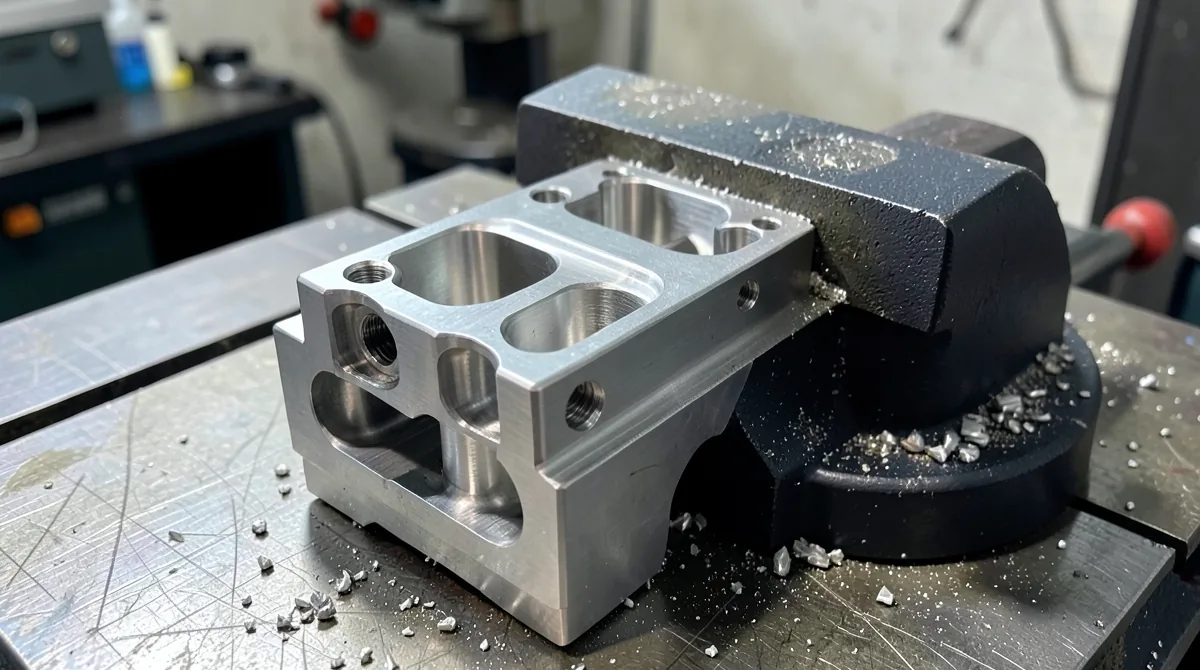
The trade is not 3-axis versus 5-axis in the abstract. It is setups versus spindle rate.
A 3-axis machine bills at a lower hourly rate. A part needing four setups on that machine gets handled four times, fixtured four times, and inspected against four opportunities for a feature to drift.
A 5-axis machine bills higher per hour. A part finished in one setup gets located once.
Where the crossover sits depends on the part. Simple prismatic work with features on one or two faces usually belongs on a 3-axis machine, and paying 5-axis rates for it is waste. Parts with features on five faces, contoured surfaces, or tight relationships between features on opposite sides tend to favor fewer setups.
The honest version, from someone who quotes this weekly, is that the answer is a calculation, not a preference. Any shop telling you 5-axis is always better is selling spindle time.
Why aerospace pushes the question hardest
The FAA’s Aerospace Forecast for fiscal years 2026 through 2046 projects the regional carrier jet fleet growing to 2,182 aircraft by 2046, up from 1,407 in 2025. The FAA’s review of 2025 also noted that supply chain constraints continued to hamper aircraft deliveries, limiting fleet optimization.
Aerospace parts tend toward the geometry that rewards fewer setups. Positioning error that repeats across four setups is a different problem than positioning error that happens once.
Questions worth asking on a milling quote
Ask how many setups the shop has planned. That single number drives more of the price than the hourly rate does.
Ask whether the programmer picks the machine or whether the schedule picks it. A part routed to whatever is open is a different part than one routed to what suits it.
Ask what happens between setups. Parts that leave the building to get a feature added have entered someone else’s queue, and backlog at that depth is not a good queue to enter.
Frequently Asked Questions
01Is 5-axis milling always better than 3-axis?
No. 5-axis machines carry a higher hourly rate, and simple parts with features on one or two faces run more economically on 3-axis equipment. 5-axis earns its cost when a part has features on multiple faces, contoured surfaces, or tight relationships between opposite sides that repeated setups would put at risk.
02How do setups affect the price of a milled part?
Each setup means fixturing, locating, and proving out the part again. Labor accumulates across every one, and so does the chance of a feature drifting between them. A part quoted at four setups on a cheaper machine often costs more than the same part finished in one setup at a higher rate.
03What is the difference between 4-axis and 5-axis milling?
4-axis adds one rotational axis to standard X, Y, and Z movement, letting the machine reach additional faces without a person repositioning the part. 5-axis adds a second rotational axis, making it possible to machine highly complex geometry in a single setup rather than across several.
04Does my part need 5-axis machining?
It depends on geometry, not on preference. Features on five faces, contoured surfaces, or critical relationships between opposite sides point toward fewer setups. A shop that runs 3, 4, and 5-axis equipment can compare the routings rather than fitting the part to whatever machine it owns.
05Why does manufacturing backlog matter when I source milled parts?
Deep backlog means queue time. Census reported unfilled orders up in twenty-four of the last twenty-five months through July 2026. Parts that move between suppliers for secondary operations enter a new queue at each stop, which makes setup count and in-house capability a scheduling question as much as a cost one.
NTM: Milling and Turning on One Floor Since 1972
Newport Tool & Machine is a family-owned CNC machine shop in Newport, Pennsylvania, run by three generations of the same family since 1972. Milling, turning, Swiss, EDM, grinding, heat treat, and inspection all happen in one 50,000 square foot building. ISO 9001:2015 certified through 2029.
Frank Warne, Brian Maneval, and Nate Kerstetter each bring 30 or more years to the milling department, and they program in Mastercam and Esprit. The person writing the program is the person at the machine.
Our Processes Include:
- CNC Milling — 25 mills with 3, 4, and 5-axis capability on Brother, Mori Seiki, Fanuc, and Feeler equipment, with pallet changers on select machines
- CNC Turning — 10 lathes with twin spindle, Y-axis, and live tooling
Not sure how many setups your part needs?
Send NTM the print and we will walk through the routing with you.
About the Author
Eric Weller is president of Newport Tool & Machine, the family-owned CNC machine shop his father Ron founded in Newport, Pennsylvania in 1972. He has been around the shop since he was four years old, back when the company ran out of the family basement on three manual machines. He joined full-time out of high school in 1989 and worked through the floor, estimating, and production planning before taking over. He is the second of three generations at NTM, and he still reviews quotes and answers customer process questions himself.
Works Cited
- United States, Census Bureau. “Monthly Full Report on Manufacturers’ Shipments, Inventories, & Orders.” CB26-135, 2 Sept. 2026, www.census.gov/manufacturing/m3/current/index.html.
- United States, Federal Aviation Administration. FAA Aerospace Forecast Fiscal Years 2026–2046. U.S. Department of Transportation, 22 July 2026, www.faa.gov/data_research/aviation/aerospace_forecasts.